



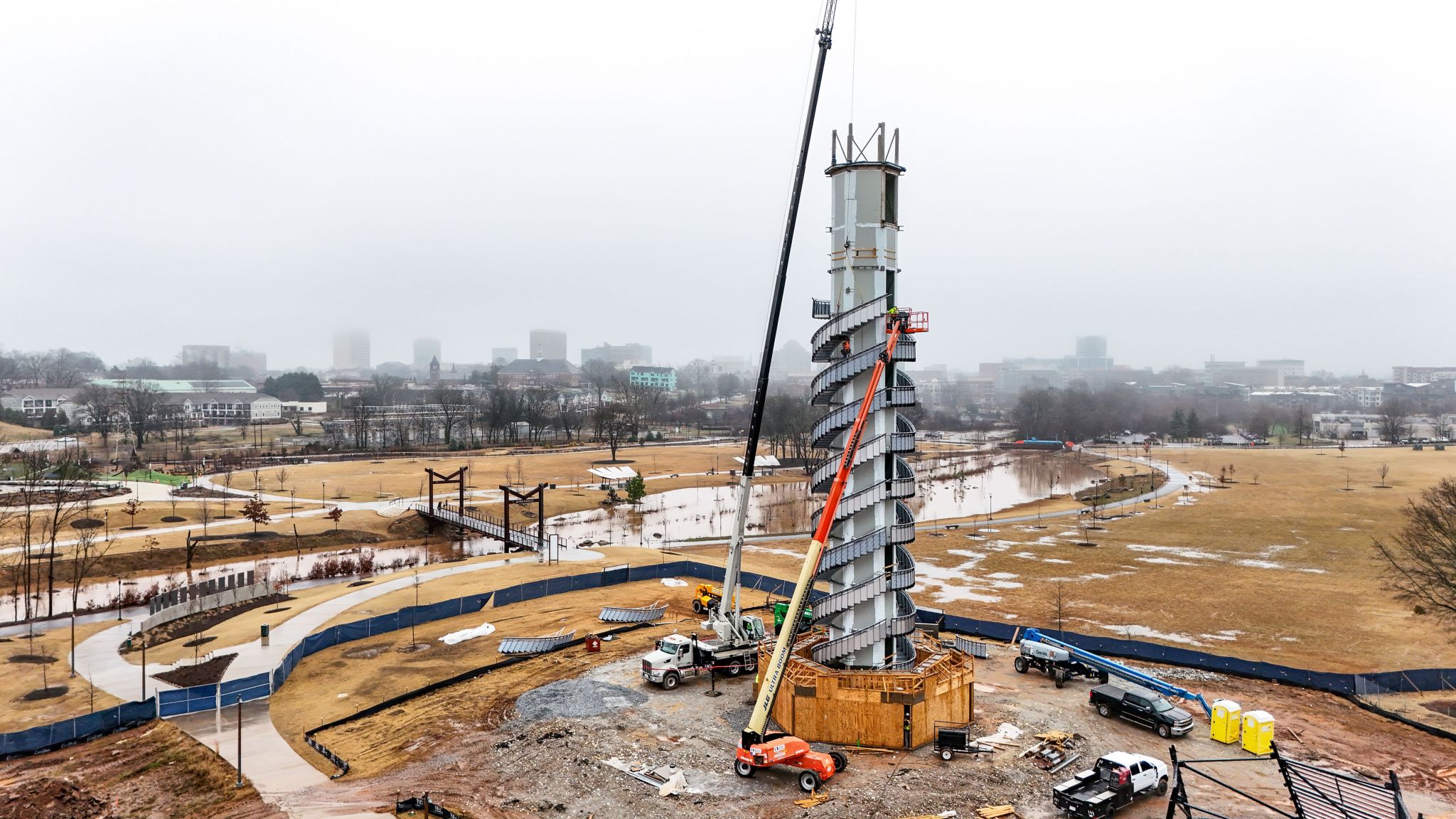
When Harper General Contractors took on the Unity Park Honor Tower in Greenville, SC, the team faced a unique challenge: installing a dual helical staircase on a 120-foot steel core that moved with the wind. Traditional survey methods and templating weren’t going to cut it. The solution? A reality capture strategy designed for precision in motion.
The Challenge
The tower’s inner core and outer exoskeleton were independent structures, and the staircase relied on 66 precisely placed brackets. Even a ¼-inch error could compound into major misalignment several floors up. Add wind-induced sway, and standard ground-based scanning became unreliable.
The Approach
Harper’s Construction Technology team mounted a Leica BLK360 laser scanner directly to the inner core, ensuring the scanner moved with the structure. Using a custom-fabricated bracket and a lift-by-lift scanning plan, the team captured high-accuracy data for every bracket location. Field crews were trained to handle scanning safely at height, while VDC specialists focused on post-processing and data packaging.
The scans were segmented by lift and shared with the specialty stair fabricator, who aligned the point clouds with their model. This allowed them to adjust parts in the shop instead of in the field.

The Results
- All stair components installed in two weeks
- Three out-of-tolerance brackets identified and corrected before fabrication
- Zero compounding errors across 22 stair sections and 20 landings
- Significant reduction in rework and improved safety
Key Takeaways
- Mounting the scanner to the structure neutralized wind-induced movement
- Segmenting scans by lift minimized error and simplified coordination
- High-accuracy data enabled proactive adjustments and streamlined installation
With reality capture, Harper turned a high-risk install into a controlled, predictable process—saving time, reducing risk, and strengthening partnerships.
Note: This is a summary of a presentation originally given at Hexagon LIVE 2025. Watch the full presentation above.
Reuse This Method
Best‑fit applications:
- Observation towers, stair cores, elevator cores
- Slender steel structures, wind‑exposed works at height
- Retrofits where as-built bracket locations govern prefabrication
- Any install where compounding tolerance is a top risk
Checklist:
- ☐ Establish control & coordinate system
- ☐ Prototype & test a structure-mounted scanning bracket
- ☐ Define lift-by-lift scan plan and field note protocol
- ☐ Segment data to local bundles; register cloud-to-cloud
- ☐ Create per-lift sitemaps tied to contract docs
- ☐ Co-review with fabricators; mark adjustments before shop release
- ☐ Capture lessons learned; templatize workflow for the next project