



In the rapidly advancing construction industry, persistent challenges like labor shortages and the demand for increased efficiency are being addressed through innovative solutions. Robotics is emerging as a transformative force, significantly influencing project timelines and costs. In a recent conversation with Jason Culp, Director of VDC and Construction Technologies at NOAR Technologies, we explored the profound impact of robotic technology on construction.
Accelerating Speed and Efficiency
Traditional construction methods are often slow and labor-intensive, resulting in prolonged project timelines. Robotics offers a compelling alternative by dramatically accelerating processes. As Jason recounts, “I witnessed a project where the manager estimated eight days and three people to complete the job traditionally. Using the Leica iCON robotic total station and HP SitePrint, we finished in three and a half hours with just one person.” This remarkable boost in efficiency not only shortens timelines but also enables companies to handle more projects, thereby increasing revenue.
Minimizing Physical Strain and Labor Costs
Robotics reduces the reliance on manual labor, thereby minimizing physical strain on workers and cutting labor costs. By automating labor-intensive tasks, companies can reassign their workforce to more strategic roles, enhancing overall productivity. Jason notes, “Once teams see the speed, they adapt their systems and quickly embrace the technology.”
Enhancing Accuracy and Precision
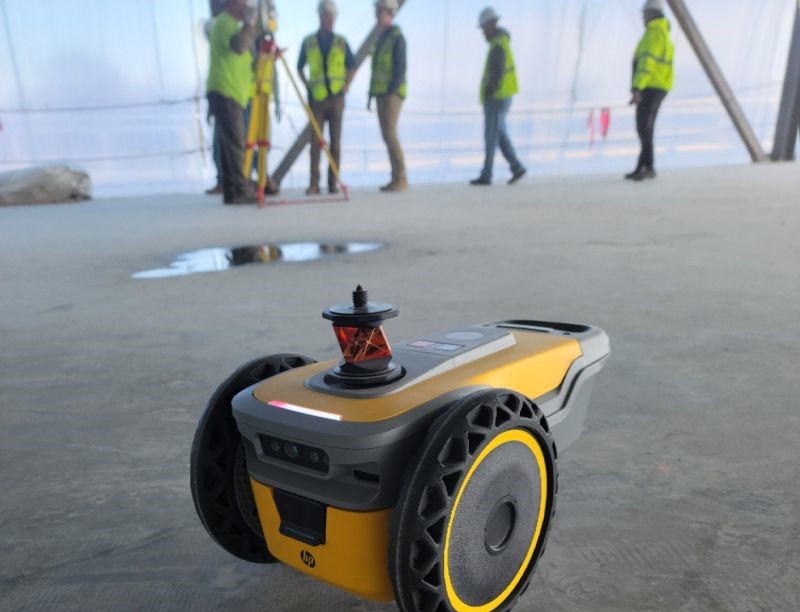
Robotic systems deliver precision that manual methods struggle to match, leading to fewer errors and reduced rework. For example, the HP SitePrint robot, which is a three-wheeled robotic printer equipped with an internal tracking prism, works with a robotic total station like the Leica iCON to align itself with a set of coordinates that have been set by the user. The prism allows the device to gauge the distance and angles needed to complete layout with an accuracy of up to 1/8 inch, surpassing typical manual methods. This precision ensures projects are executed correctly the first time, saving both time and resources.
Overcoming Initial Skepticism
Adopting new technology often meets with skepticism, especially in an industry steeped in tradition. However, once the benefits become clear, resistance typically diminishes. Jason shared an example where a company performed a preliminary manual layout of the site, only to find the robot matched every point precisely, leaving them impressed.
Realizing Long-term Cost Savings
Investing in robotic technology pays off in the long run. The initial expense is offset by decreased labor costs, quicker project completion, and the capacity to undertake more projects. As Jason explains, “You can complete more projects faster and more efficiently for just the initial cost of the product.”
A Necessary Evolution
The integration of robotics in construction is not just a trend but a necessary evolution for the industry. By significantly reducing project timelines and costs, robotics is paving the way for a more efficient, precise, and profitable future in construction. Companies that embrace this technology will not only stay competitive but thrive in the modern construction landscape.
For more insight on how to harness robotics and digital layout for your projects, contact us.